


English
Views: 0 Author: HOLRY Spindle Motor Publish Time: 2026-08-29 Origin: Site


In the field of CNC machining, conventional standard spindles can handle basic cutting tasks. However, when it comes to high-precision machining, long-term continuous mass production, and complex or harsh operating environments, standard spindles can quickly reveal their limitations.
A high-performance CNC spindle is not simply about having better specifications on paper. It represents a comprehensive upgrade in bearing rigidity, dynamic balancing, torque output stability, heat dissipation, environmental protection, and other critical areas. These factors directly determine machining yield, production efficiency, and the long-term stability of CNC equipment after deployment in overseas markets.
This article provides a systematic overview of high-performance CNC spindle solutions, covering the operating principle of CNC spindle motors, major product classifications, performance differences across machining applications, five key selection criteria, the selection logic between air-cooled and water-cooled spindles, spindle and VFD matching solutions, and troubleshooting methods for common on-site failures.
It also provides practical purchasing recommendations for international buyers, offering a comprehensive overview of HOLRY's full range of high-performance CNC spindle solutions to help overseas customers select the right spindle, reduce failure rates, and improve the overall competitiveness of their CNC equipment in global markets.
A CNC spindle motor is a variable-frequency, high-speed motor specifically developed for CNC machinery. It is fundamentally different from conventional industrial motors designed for standard 50/60 Hz power-frequency applications.
Traditional industrial motors are primarily designed for general-purpose applications with constant speeds and relatively stable loads. Their functions and precision are limited. In contrast, CNC spindle motors use dedicated variable frequency drives (VFDs) to provide stepless speed control across a wide 0–400 Hz frequency range.
This allows them to adapt flexibly to various CNC machining operations, including milling, engraving, slotting, drilling, grinding, and polishing. They can support both high-speed precision machining and low-to-medium-speed heavy-duty cutting, while meeting strict requirements for constant torque output, high-speed dynamic balancing accuracy, bearing rigidity, impact resistance, and thermal stability.
A high-performance CNC spindle takes the standard CNC spindle concept further through comprehensive mechanical and electrical enhancements. It uses higher-grade bearings, optimized rotor dynamic balancing, upgraded winding insulation and cooling structures, and reinforced sealing and protection. The torque curve, impact resistance, and long-term temperature-rise performance are also specifically optimized for demanding applications.
Conventional standard spindles are generally suitable for light-load and intermittent production, while high-performance spindles are designed for mass production, precision machining, long operating hours, and demanding industrial environments commonly encountered in overseas applications.
1. Ultra-Wide Speed Control Range
Most mainstream industrial CNC spindles use a base frequency of 400 Hz, with rated speeds reaching up to 24,000 RPM. High-end precision models can exceed 60,000 RPM.
The high-speed range is suitable for fine engraving, precision carving, and mirror polishing, while the low- and medium-speed ranges provide the torque required for thick-board slotting and heavy-duty milling. The full speed range can therefore accommodate a wide variety of machining applications.
High-performance models are specifically optimized to suppress vibration throughout the speed range, minimizing high-speed vibration and low-speed torque loss.
2. High Resistance to Cyclic Impact Loads
CNC machining is characterized by intermittent cutting operations, in which the tool repeatedly enters and exits the workpiece, generating instantaneous impact loads.
High-performance CNC spindles optimize winding structures and bearing rigidity for these operating conditions. They can withstand frequent impact loads over extended periods while reducing speed drops, stalling, and other failures caused by sudden load fluctuations.
3. 24/7 Continuous Production Capability
Industrial-grade high-performance CNC spindles use high-temperature-resistant insulation materials and optimized cooling structures. Their excellent heat resistance and aging resistance allow them to support factory production schedules ranging from 8 to 24 hours per day.
Even under prolonged full-load operation, temperature rise remains controlled and performance stays stable, reducing performance degradation caused by extended operating periods.
4. Precise CNC System Synchronization
High-performance CNC spindles can interface with a wide range of CNC control systems and receive 0–10 V analog speed-control signals.
The spindle can adjust its speed precisely according to machining programs in real time, helping maintain consistent machining accuracy across batches and making it suitable for automated production lines.
High-performance models provide tighter speed fluctuation control, resulting in higher consistency during mass production.
Different machining applications place very different demands on CNC spindle motors. Blindly replacing a high-performance spindle with a standard model is one of the major causes of frequent equipment failures in overseas markets.
Woodworking and Signboard Processing
These applications typically involve frequent impact loads. High-performance spindles focus on low vibration at high speeds, effective dust sealing, and stable heat dissipation.
The priority is to achieve burr-free edges, uniform machining patterns, and stable accuracy during long production cycles.
Metal Machining Centers
Metal machining focuses on heavy-duty milling of hard materials such as steel and aluminum alloys.
The key requirements for high-performance spindles are high torque at low speeds, high rigidity, and strong overload resistance, preventing speed loss and stalling during heavy cutting.
Stone Processing
Stone-processing workshops often have high dust concentrations and significant load fluctuations.
High-performance spindles therefore emphasize improved sealing, wear-resistant bearings, and vibration resistance to extend service life and reduce bearing replacement frequency.
Precision Engraving and Milling
These applications focus heavily on surface finish and dimensional accuracy.
High-performance spindles are designed for extremely low runout, ultra-high dynamic balancing accuracy, and highly stable rotational speeds to minimize surface waviness and machining marks.
High-performance CNC spindle motors available in the global export market are primarily classified according to two factors: cooling method and tool-changing structure.
Even among air-cooled or water-cooled models, high-performance versions typically feature upgrades in bearings, sealing, dynamic balancing, and cooling structures compared with conventional models.
Different spindle configurations are suited to different markets, operating environments, and maintenance conditions, making these factors essential when selecting CNC spindles for international projects.
High-performance air-cooled CNC spindles use a high-speed, low-noise fan at the rear of the spindle to provide forced-convection cooling.
They do not require external water tanks, pumps, or cooling pipes. Their integrated design simplifies installation and eliminates water-circuit maintenance, making them highly reliable for overseas markets where maintenance resources may be limited.
Compared with standard air-cooled spindles, high-performance models feature optimized airflow channels that reduce the transmission of fan vibration to the spindle body.

SPF-7.5 Air cooled spindle motor

9.0KW Air Cooled Spindle Motor
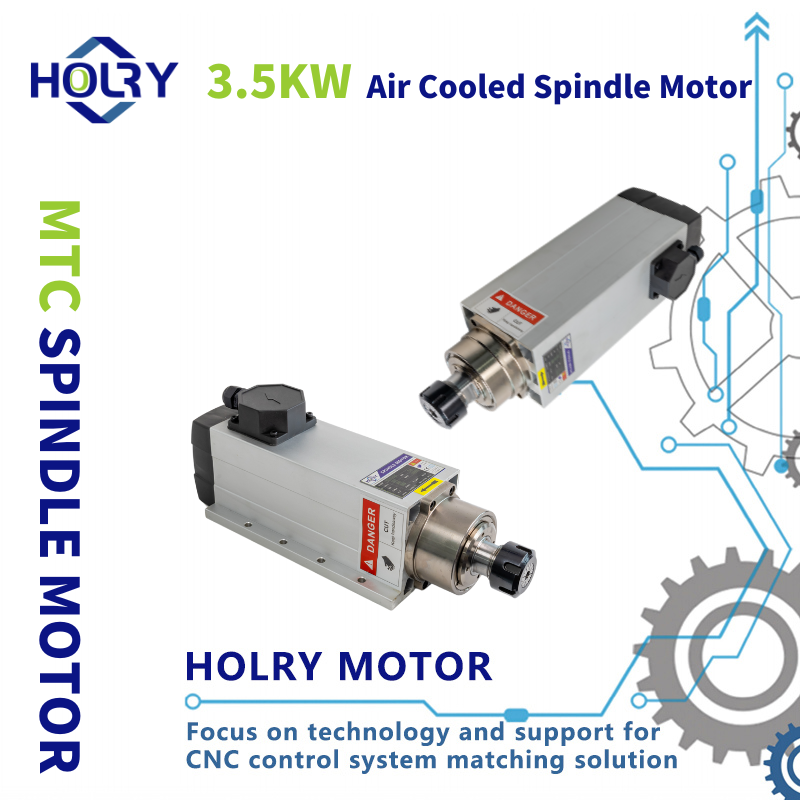
3.5KW Air cooled spindle motor
Key Advantages
There is no risk of water leakage, and environmental adaptability is excellent. These spindles are particularly suitable for workshops with high temperatures, limited water availability, high dust levels, or insufficient maintenance personnel.
Their simple structure contributes to low failure rates and lower after-sales service requirements, while keeping the overall equipment cost manageable for volume purchases.
Limitations
At the same power rating, the maximum cooling capacity of an air-cooled spindle is lower than that of a water-cooled spindle.
During long-term, full-load heavy-duty machining, some temperature rise may occur. The cooling fan also produces a small amount of operating noise.
Applications and Target Markets
Typical applications include woodworking engraving, advertising board cutting, light routing, and thin-sheet processing.
They are particularly suitable for Southeast Asia, the Middle East, Africa, South America, and other overseas markets where maintenance infrastructure may be relatively limited.
Available power ranges generally cover 0.8 kW–7.5 kW, making these spindles suitable for export equipment where high reliability and water-free maintenance are priorities.
High-performance water-cooled CNC spindles feature an optimized internal circulating cooling-water system. Continuous circulation removes heat from the spindle body, providing uniform cooling and precise temperature control.
They are a core configuration for industrial-grade heavy-duty and mass-production equipment.
High-performance models feature reinforced water-circuit sealing and optimized heat-transfer paths for the bearings and windings.
Key Advantages
Temperature rise remains very low during continuous full-load operation. Low operating noise and reduced vibration contribute to better workpiece surface finish.
The slower aging of bearings and windings can significantly extend equipment service life, making water-cooled spindles particularly suitable for 24/7 heavy-duty production.
Limitations
A complete water-cooling system is required, increasing equipment assembly cost and installation complexity.
In cold-climate overseas markets, antifreeze should be added to prevent the cooling circuit from freezing.
During long-distance sea transportation and extended operation, there is also a potential risk of minor leakage, making regular coolant maintenance necessary.
Applications and Target Markets
Typical applications include metal engraving and milling, stone processing, heavy-duty routing of thick materials, and precision mold machining.
These spindles are particularly suitable for high-end markets such as Europe, North America, Australia, Japan, and South Korea, where equipment precision requirements and factory maintenance capabilities are generally higher.
Power ratings typically range from 1.5 kW to 11 kW.
MTC Manual Tool-Change High-Performance CNC Spindle
MTC spindles use high-precision ER standard collets and a manual wrench-based tool-changing structure.
Their simple construction provides a low failure rate and competitive purchasing cost without requiring complex electrical control systems.
They are a mainstream high-performance configuration for small- and medium-sized standalone CNC machines, particularly for low-volume production and flexible multi-product machining.
Their simplicity also makes export delivery and after-sales maintenance easier.
High-performance versions improve collet matching accuracy to reduce radial runout.
ATC Automatic Tool-Change High-Performance CNC Spindle
ATC spindles incorporate a high-precision pneumatic tool-clamping mechanism and can work with CNC control systems to perform automatic tool changes without manual intervention.
This significantly improves the productivity of automated production lines.
Due to their higher technical requirements and more precise assembly and commissioning, ATC spindles need to be matched with dedicated intelligent VFDs to ensure correct tool-changing sequences.
They are mainly used in high-end machining centers and automated production lines, targeting advanced industrial markets.
High-performance ATC spindles require strict control of tool-clamping force stability and repeat positioning accuracy.
Ten years of global export experience has demonstrated that selecting a spindle based solely on power rating can easily lead to compatibility problems.
When purchasing high-performance CNC spindles, overseas buyers should evaluate five core factors while considering local power grids, climate, machining conditions, and maintenance capabilities.
0.8 kW–2.2 kW: Suitable for small engraving machines, thin-sheet sign engraving, light slotting, and other light-cutting applications.
3.0 kW–4.5 kW: Mainstream power range for general applications worldwide, suitable for woodworking routing and standard metal engraving and milling while balancing productivity, precision, and cost-effectiveness.
6.0 kW–7.5 kW: Heavy-duty power range suitable for thick-board slotting, stone processing, and medium-load aluminum alloy milling.
8.0 kW–11 kW and above: Industrial heavy-cutting models designed for high-material-removal steel milling and high-end mold machining centers.
Key Selection Tip
For applications involving impact cutting, the power rating should generally be selected one level above the minimum requirement.
Long-term operation at full rated power should be avoided because sufficient power headroom helps extend spindle service life and reduce overload failures.
A high-performance spindle does not mean unlimited overload capability. Proper power margin remains essential for long-term stable operation.
Bearings are among the most critical wear components in a CNC spindle and directly affect machining accuracy and service life.
Low-end general-purpose spindles often use standard-grade bearings, which can easily develop excessive runout, abnormal vibration, noise, and surface waviness under high-speed impact cutting.
HOLRY high-performance CNC spindles are equipped with P4-grade high-speed precision bearings across the product range and undergo multiple high-speed dynamic balancing corrections before shipment.
This effectively reduces cutting-induced vibration and supports long-term continuous production in overseas applications, providing significantly improved stability and durability compared with conventional market products.
The industrial standard for many CNC spindles is a 400 Hz base frequency with a rated speed of 24,000 RPM.
The 0–400 Hz range serves as the core constant-torque region. The smoother the torque output, the stronger the spindle performs during low-speed heavy-duty cutting, minimizing speed loss and stalling.
Above the base frequency, the spindle enters the constant-power range, which is suitable for high-speed precision engraving.
High-performance spindles feature carefully optimized torque curves. Buyers should therefore verify the torque curve during selection to avoid products that suffer from weak low-speed performance or unstable high-speed operation.
Small-power spindles are generally available for single-phase 220–230 V applications, targeting residential, light-industrial, and small-machine markets.
High-power industrial CNC spindles typically use three-phase 380–415 V industrial power supplies.
For regions such as India and Southeast Asia where voltage fluctuations can be significant, HOLRY can provide wide-voltage customized versions with overvoltage, undervoltage, and phase-loss protection to improve compatibility with unstable overseas power grids.
For overseas workshops exposed to high temperatures, humidity, and high dust concentrations, HOLRY high-performance CNC spindles feature optimized sealing structures and upgraded winding insulation.
These improvements help protect against dust, moisture, and electrical leakage while reducing the risk of winding damage caused by dust or moisture ingress.
As a result, the spindles provide improved adaptability to demanding overseas operating environments.
Based on data from overseas projects over the past decade, approximately 80% of CNC spindle failures are not caused by the spindle motor itself, but by incorrect VFD selection or improper parameter commissioning.
High-performance CNC spindles are high-frequency variable-frequency devices and should never be driven by ordinary general-purpose industrial VFDs.
Even the best spindle cannot deliver its intended performance if it is paired with an unsuitable VFD.
1. High-Frequency Output Capability
The VFD must support precise frequency and voltage control from 0–400 Hz to fully meet the high-speed speed-control requirements of CNC spindles.
2. Sufficient Overload Capacity
Because machining can generate instantaneous cutting currents, the VFD power rating should be increased by one level for heavy-duty applications to prevent overcurrent alarms.
3. Comprehensive Electrical Protection
The VFD should integrate multiple protection functions, including overcurrent, overvoltage, overheating, phase-loss, and overload protection, making it suitable for complex overseas power-grid conditions.
4. Dedicated Timing Compatibility
ATC automatic tool-change spindles must be paired with intelligent dedicated VFDs capable of coordinating the automatic tool-change sequence to ensure smooth and reliable tool changes.
1. Basic Parameters
Accurately enter the spindle nameplate voltage and current, set the base frequency to 400 Hz, and match the rated speed.
2. Acceleration and Deceleration Parameters
For impact-load applications, an acceleration/deceleration time of approximately 3–6 seconds can be used to reduce shutdowns and error alarms caused by instantaneous high currents.
3. Protection Parameters
Enable all applicable electrical protection functions to accommodate complex overseas power-grid conditions.
4. Signal Interface
Use a 0–10 V analog signal to connect the VFD with the CNC control system for precise spindle speed tracking.
All HOLRY high-performance spindle and VFD packages are pre-commissioned with dedicated operating parameters before shipment.
This allows overseas customers to complete installation with simple wiring and start production quickly, significantly reducing technical barriers and after-sales service costs.
Typical causes include insufficient VFD torque, inadequate power margin, incorrect V/F parameters, or worn collets and cutting tools.
Recommended solutions include recalibrating VFD parameters, upgrading to a heavy-duty VFD, and replacing wear components regularly.
Even a high-performance spindle can experience these problems if it is paired with an unsuitable VFD.
This is often caused by bearing wear or dynamic-balance deterioration resulting from long-term impact loads.
Use industrial spindles with high-precision bearings, avoid continuous overload operation, and perform regular maintenance.
Even high-performance spindles will experience accelerated wear if continuously overloaded.
The instantaneous cutting current may exceed the load capacity of a standard VFD.
The solution may be to appropriately adjust the overload threshold or, preferably, upgrade to a dedicated heavy-duty spindle VFD.
Long-distance transportation vibration can loosen fittings, while failure to use antifreeze in cold regions can cause the cooling circuit to freeze and crack.
HOLRY reinforces sealing connections before shipment and provides English-language antifreeze and cold-weather operating instructions.
Based on more than ten years of international project experience, the following purchasing guidelines can be directly applied by overseas CNC equipment manufacturers:
For markets with limited water availability, weak maintenance infrastructure, high temperatures, or heavy dust, prioritize high-performance air-cooled spindles.
For heavy-duty mass production and high-precision machining, prioritize high-performance water-cooled spindles.
For automated production lines, select ATC automatic tool-change models according to actual production requirements.
Impact-cutting applications should not operate continuously at full rated power. Appropriate load headroom helps extend spindle service life.
Purchasing high-performance spindles together with dedicated VFDs helps prevent parameter incompatibility and disputes over after-sales responsibility that can occur when the two components are purchased separately.
Confirm that the supplier provides complete English manuals, wiring diagrams, and parameter tables.
Make sure wear parts can be ordered separately and request key technical documentation such as spindle inspection reports and dynamic balancing specifications.
For new suppliers, it is recommended to conduct sample-machine testing first.
Verify machining accuracy, temperature rise, vibration, and noise under actual operating conditions before proceeding with full-container or large-volume purchases.
This can significantly reduce procurement risks.
No.
HOLRY also offers high-performance air-cooled spindles for overseas markets with high temperatures, limited water availability, or restricted maintenance capabilities.
Water-cooled spindles provide greater advantages in long-term heavy-duty operation, low-noise applications, and high-precision machining.
No.
High performance is a comprehensive upgrade involving bearing grade, dynamic balancing, torque characteristics, environmental protection, cooling performance, and other factors.
At the same power rating, standard and high-performance spindles can differ significantly in impact resistance and long-term operating stability.
Generally, no.
Standard VFDs may not provide sufficient frequency range for the 0–400 Hz high-frequency speed-control requirements of CNC spindles.
Improper matching can result in speed loss, overheating, or winding damage.
A dedicated high-frequency spindle VFD should therefore be used to achieve the intended performance of a high-performance CNC spindle.
For small- and medium-sized standalone machines and flexible low-volume production, MTC manual tool-change spindles offer a more cost-effective solution.
For high-end automated production lines and multi-process mass production, ATC automatic tool-change spindles are the better choice.
Yes.
HOLRY supports sample orders and large-volume OEM customization.
Customized solutions can be developed according to target-market voltage requirements, protection requirements, operating environments, and other application conditions to meet the diverse purchasing needs of overseas customers.
A high-performance CNC spindle is the core power system of high-end CNC equipment. Spindle selection should never be based solely on rated power.
Cooling method, bearing precision, torque curve, tool-changing structure, VFD configuration, power-grid compatibility, environmental resistance, and other factors collectively determine machining accuracy, production efficiency, failure rates, and total operating costs.
Many after-sales problems encountered by overseas CNC equipment users originate from ignoring differences in operating conditions and using standard spindles as substitutes for high-performance configurations.
The result can be reduced production capacity, higher maintenance costs, and damage to the equipment supplier's reputation.
With 25 years of experience in CNC spindle R&D and manufacturing, HOLRY combines mature electrical control and commissioning technology with extensive international project experience to provide a complete range of high-performance CNC spindle solutions.
The product portfolio covers air-cooled, water-cooled, MTC, and ATC configurations and supports applications including woodworking, metalworking, stone processing, and precision engraving and milling.
HOLRY can also develop customized solutions based on voltage requirements, climate conditions, and operating environments in different global markets.
All products are pre-configured before shipment and undergo strict dynamic balancing inspections. Complete English technical documentation and export-related certifications are also available.
HOLRY supports sample orders and high-volume OEM customization, helping overseas CNC equipment manufacturers solve spindle selection challenges, reduce field failures, and minimize after-sales costs.
If you need high-performance CNC spindle selection, customized machining solutions, or FOB pricing, please contact the HOLRY technical and international sales team.


